Get your free Window EER.
Make your windows work harder for your home with a free window covering EER.
The right window furnishings can play an important role in keeping your home comfortable year-round – helping to reduce unwanted heat in summer, retain warmth in winter and lessen your reliance on heating and cooling.
As a WSAA Member, CBI Blinds & Awnings has exclusive access to the WincovER tool to help you look beyond style, privacy and light control to understand the potential energy and cost savings your chosen window furnishings could deliver for your home.

See the potential difference before you decide.
Not all window furnishings perform in the same way. The type of product you choose, its properties, where you live and even how you use it can all influence its impact on your home's energy efficiency.
What’s included.
As part of our free service, we can provide an indicative estimate of the potential difference suitable window furnishings could make to your home's:
Heating & cooling energy useSee how your window furnishings could reduce the energy required to maintain a comfortable home.
Household energy costsUnderstand what improved window performance could mean for your estimated heating and cooling costs over a year.
Household emissionsSee the potential reduction in emissions associated with using less energy to heat and cool your home.
FAQs.
-
Window coverings can help you save heating and cooling energy in two ways:
They can provide a thermally insulating layer that covers the window
They can reduce the amount of heat from the sun coming into the house
Most window coverings are operable which means that you can open and close them to change the amount of insulation and sun to suit the weather conditions and your preferences.
A thermally insulating layer slows down the flow of heat. All building materials and constructions provide some level of thermal insulation. Windows generally provide less thermal insulation than walls, especially older windows made up of single panes of glass. If heat from your home is leaking out of your windows in winter, or if too much heat is coming through the windows in summer, an added layer of insulation over the windows provided by a window treatment can reduce the energy needed for heating and cooling in your home.
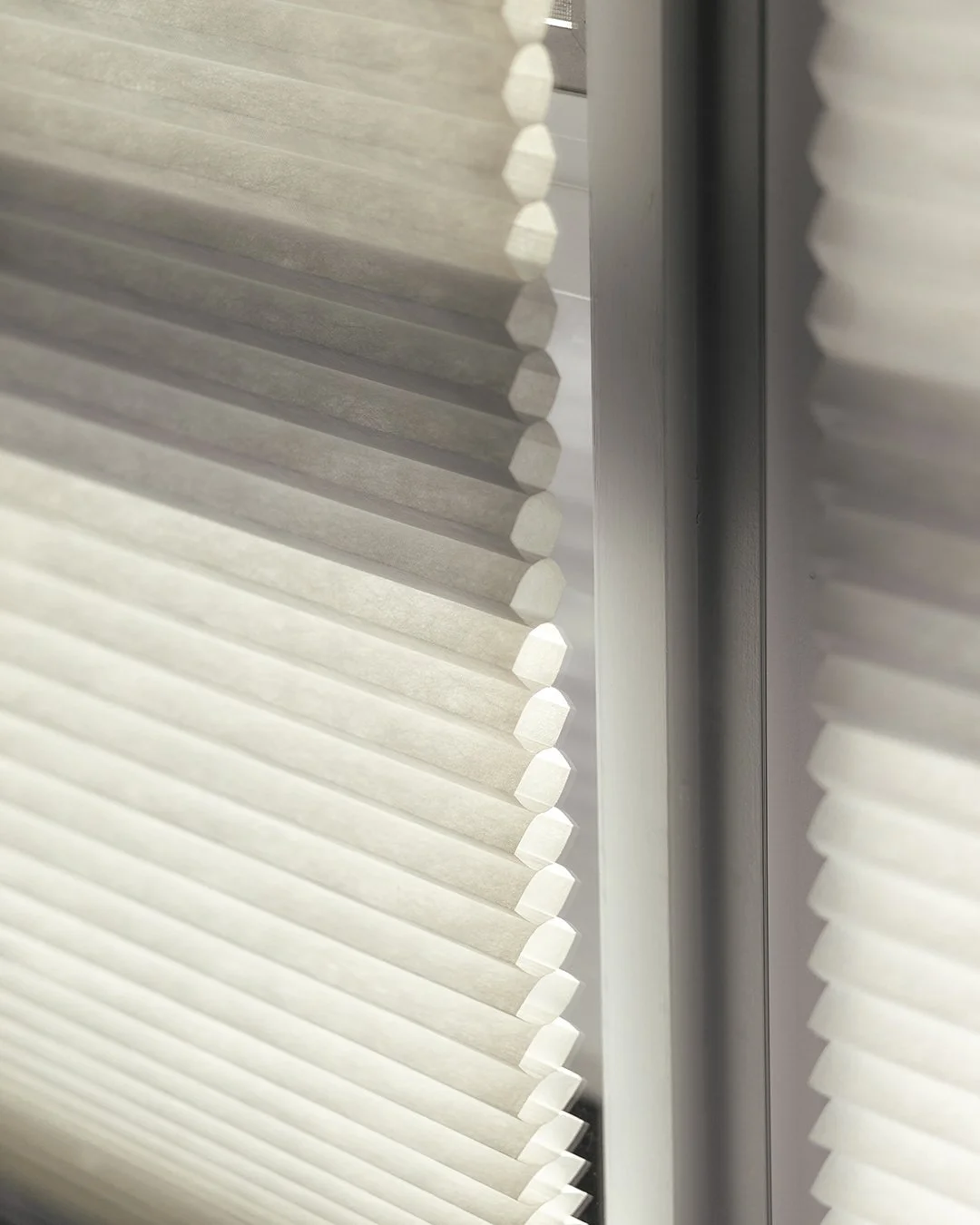
Indoor window coverings that have enclosed air pockets such as honeycomb blinds, thick lined curtains or foam-filled shutters can provide the most insulation. However, that’s not the end of the story. To be effective, the insulating layer needs to completely cover the window – if there is any ‘shortcut’ for heat to take, the insulation can be bypassed. Air currents form next to the window because cold air is heavier than warm air – when the surface of the window is cold compared to the room air, an air current will form falling down over the window. The warm room air is drawn over the cold window surface by this air current and chilled. If this air current is not blocked off on all sides of the window, the circulating chilled air will act to cool the room even if the window covering itself is thick and insulating. If it is hot outside, the surface of the window heats the air next to it and forms a rising air current that can heat the room. This is why window coverings that are tightly closed on all edges will save much more heating and cooling energy than coverings that have gaps that allow air to pass behind the window covering. Examples of mounting options that can enclose the window are roller blinds or honeycomb blinds with cassette mounting or side channels and curtains with pelmets that touch the walls and window sill or floor on all sides. Not all window covering types can accommodate this type of mounting. If it is not possible to completely block all the air gaps, mounting options with the smallest possible gaps on all sides will make the window covering more effective at providing insulation.
To reduce the amount of heat from the sun coming into the house, choose an external or an internal window covering that can reflect the sun back through your window. This means choosing a window treatment that lets less light pass through and which has a light colour facing the outdoors.
External window coverings are very effective at preventing unwanted heat from the sun from entering your home. Choose an opaque option or a window covering that lets little light through to reduce the amount of heat from the sun coming inside. Operable external window coverings can be opened in winter to allow free heat from the sun to warm your home.
Internal window coverings can also be effective at reducing the amount of sun entering the home. Internal window coverings made of a light coloured material, or with a light coloured lining on the side facing outdoors will work best. Dark materials will absorb the sunlight and re-radiate that heat into your home, so they are less effective at reducing the amount of cooling energy your home needs. Also remember that to be effective at reducing cooling energy, the window covering should have the smallest possible air gaps on all sides to help prevent the warm air current heated by the window surface from entering the room.
-
To save more heating energy, choose a mounting option that reduces the air gaps around the edges of the window covering where possible.
To save more cooling energy, choose a window covering material that lets through less light and choose a material with a lighter colour facing the outdoors.
-
This WincovER simulator helps you understand how different window coverings can affect the energy use and running costs of your home based on location, building type, building age and window covering choice.
Behind the scenes, the tool uses a large database of detailed building energy modelling results. What you see is a summary of those results matched to your home and location and the window covering you are interested in.
The simulator is based on computer modelling of real Australian homes
The simulator is based on computer modelling of the energy requirements of a home over a year. The computer model uses the details of the design and construction of the home and the weather conditions for the home’s location to predict the energy required to keep the home comfortable for the occupants. The model runs for each hour over a year. The energy modelling uses AccuRate, the same calculation engine used in Australia’s federal government Nationwide House Energy Rating Scheme (NatHERS), and follows the same general modelling process.
The data used by the simulator is based on modelling results from hundreds of thousands of combinations of:
Home types
Locations
Window coverings
Operating patterns
The simulator is a simple online tool we can use to help you find the closest match to your situation out of all the combinations we model, summarising the results in terms of energy, cost and emissions savings.
-
Both internal and external window covering are included in the tool, but the assumptions about when these coverings are operated are different, so keep that in mind when comparing the estimated energy and cost savings.
Also, the building energy simulations that the tool is based on do not account for any thermal insulation provided by external window coverings, so you will find that there are no heating energy savings estimated by the tool with external window coverings – this is a limitation of the simulations. Some types of external window coverings such as insulated roller shutters can in fact make a difference to your heating energy if you operate them appropriately.
-
This tool only estimates how much energy would be required to heat or cool your home to keep the indoor air at a comfortable temperature indoors – this does not tell you how hot or cold your home might get if you do not use the heater or air conditioner. If you need a lot of energy to heat or cool your home, that is a strong indication that it would be uncomfortable indoors without heating or cooling. A home that needs less energy for heating and cooling is comfortable more of the time without heating and cooling. In other words, it will be warmer inside with a window covering that saves heating energy, even with the heater off, and it will be cooler inside with a window covering that saves cooling energy, even with the air conditioner off.
Window coverings can also influence how comfortable you feel when sitting close to windows. Windows usually let significantly more heat pass through than the surrounding walls. When it is very hot or cold outside, this means that the surface of the window and the surrounding window frame can be a lot warmer or cooler than the indoor air. If you are sitting close to the window, you may be uncomfortable due to this difference in temperature even if the room air is the right temperature, because you will feel the radiating influence of the hot or cold window surface. The warm or cool window surface can also cause uncomfortable air drafts, usually felt near the floor. External window coverings can help reduce the temperature of the window and window frame if they are getting too hot, and indoor window coverings can cover the window surface with a layer closer to the room temperature, both of which should make sitting close to the window more comfortable.
-
Appropriate window coverings can help you to feel more comfortable and save some energy in your older home, but they only cover your windows. If your roofs and ceilings, floors and walls are all letting heat out in winter or heat in in summer because of lack of insulation or air leaks, even the most effective window coverings will not be able to fix those issues. If you can improve the weather-tightness of your home and add insulation, your windows may be the remaining ‘weak link’ in keeping your home comfortable. Adding window coverings along with insulation and weatherproofing in your home will then be significantly more effective at making a difference in the comfort and energy use of your home.
-
If you have already weatherised and added insulation to your older home, but have not replaced the windows, your windows are likely to be the ‘weak link’ in keeping heat in in winter and heat out in summer. Appropriate window coverings can be very effective at reducing the heat loss through windows in winter and reducing heat gain in summer. This will make a big difference to your comfort and energy bills.
If you have upgraded your windows to double glazing, the new windows will be much better at keeping your home comfortable, but they are still usually significantly less insulating than the walls around them. Indoor window coverings can help you to save even more heating and cooling energy by adding an additional layer of insulation over the window. If your double glazed windows do not have adequate window coverings, heat from the sun will be trapped indoors – although this is beneficial when it is cool outside, it can quickly lead to overheating when the weather warms up. Adding internal or external window coverings can help block heat from the sun at times when it is unwanted, which will reduce your home’s need for cooling energy.
-
A home with a high star rating has been designed to reduce the need for heating and cooling energy, so it should be comfortable a lot of the time. There are still ways in which window coverings can help you to be more comfortable and to use less energy. If your heating bills are higher than your cooling bills, your home will be primarily designed to keep you warm in winter by letting in plenty of free heat from the sun and by using double glazing and insulation to keep heat inside. In hot and sunny conditions, this design can result in your home rapidly becoming too hot. This might happen in the ‘shoulder seasons’ of Spring and Autumn, when the sun is still low in the sky and the weather is variable – the low sun angle means that external window coverings designed for high Summer sun angles is not as effective. Operable internal and external window coverings can be very effective for reducing overheating in highly insulated homes by blocking unwanted heat from the sun.
Even in homes with a high star rating, windows are often the ‘weakest link’ in the barrier between outdoor conditions and indoors. Windows usually let significantly more heat pass through than the surrounding walls. When it is very hot or cold outside, this means that the surface of the window and the surrounding window frame can be a lot warmer or cooler than the indoor air. If you are sitting close to the window, you may be uncomfortable due to this difference in temperature even if the room air is the right temperature, because you will feel the radiating influence of the hot or cold window surface. The warm or cool window surface can also cause uncomfortable air drafts, usually felt near the floor. External window coverings can help reduce the temperature of the window and window frame if they are getting too hot, and indoor window coverings can cover the window surface with a layer closer to the room temperature, both of which should make sitting close to the window more comfortable.
-
No, this tool is currently for residential properties only.
-
Indoor
The WSAA recommends that indoor window coverings are closed at night in the heating season to keep heat in and closed during the day in the cooling season to keep unwanted heat from the sun out. In addition, window coverings should also be closed on hot sunny days in the heating season to protect the home from overheating. Window coverings should be open during the day in the heating season to let in free heat from the sun and open at night where practical in the cooling season to help the house cool down. A location-specific guide is available here
For calculating home energy ratings, NatHERS uses a standard operation schedule for indoor window coverings. This has the window coverings closed at night all year and closed during the day during hot and sunny conditions. More information is available in the NatHERS Software Accreditation Protocol. Note that the NatHERS schedule is not intended to be a recommendation for how to operation your window coverings, but is an assumption on how window coverings are operated that is used when calculating a home energy rating.
Outdoor
For external window coverings, where daily operation of the covering may be more difficult, the WSAA recommends keeping the window covering fixed in place over the cooling season and removed or retracted in the heating season. The NatHERS schedule will close external window coverings in hot and sunny weather.
Differences
The two schedules are very similar for the heating season / winter conditions in most climates, and so there will be only minor differences in the amount of heating energy savings between the two schedules.
The two schedules will result in different operation patterns for the cooling season / summer conditions and for times when overheating protection may be needed (ie. warm sunny weather during the heating season). You will find that the WSAA schedule will result in larger cooling energy savings, particularly in warmer climates.
-
The WSAA recommended schedule is a simple strategy that will give you close to the maximum possible energy savings that you can achieve by operating your window coverings. If you do not follow the recommended schedule, you can expect to save less energy overall. The recommended schedule does not account for factors such as light, view and privacy, so you will need to balance energy savings with these other considerations when choosing when to operate your window coverings.
Operating your window coverings consistently will give you the best energy savings. Many types of window coverings can be motorised and operated automatically – this can greatly increase your overall energy savings by ensuring your window coverings consistently follow an appropriate schedule.
-
By reducing the amount of heat from the sun entering your house, window coverings can help to reduce the need for cooling energy. To keep unwanted heat outside, window coverings should not allow much light to pass through, and they should reflect as much as possible back outdoors.
For internal window coverings, the colour of the side of the covering that faces outdoors makes a difference in how much sunlight is reflected back through the window by the covering when it is closed. Some window coverings look the same from each side, but some may have a coating, a lining or a different colour on the front and back side. For saving energy, the side facing the outdoors is important - light coloured materials or bright metallic coatings are the most effective at reflecting sunlight and can help you to save cooling energy by reducing the amount of heat from the sun entering the house. Dark coloured materials absorb sunlight and heat up, they can then re-radiate this heat inside your home which will increase your need for cooling. If you want to reduce cooling energy and have dark coloured window coverings as viewed from inside, make sure they have a light coloured or bright metallic lining that faces outdoors.
For external window coverings, the colour of the covering is less important than how much sunlight the covering lets through because any heat absorbed by the covering remains outside the building. To reduce cooling energy with external window coverings, look for opaque or blockout materials or materials that let little light through.
-
Many older buildings have little or no insulation and tend to have a lot of small gaps allowing air to leak in and out of the building. Building materials and methods of construction used in the past contribute to this. Homes that were built after building regulations came into effect specifying insulation levels can be assumed to have at least the minimum level of insulation, as well as updated materials and construction methods. We use the age of your home to match the construction materials and details in the building model to realistic settings.
-
Use your main living room to decide:
I have a view of the sunrise -> you are facing East
I have a view of the sunset -> you are facing West
In winter, the floor of my apartment gets some sunlight in the middle of the day-> you are facing North
In winter, the floor of my apartment doesn’t get any sun in the middle of the day -> you are facing South
-
The amount you pay for electricity or gas (your bill total) has several components. The % energy savings we estimate are related to the amount you pay for heating and cooling only. What portion of your total energy bill is due to heating and cooling your home will depend on your location, your home and your lifestyle (how much energy is needed for uses other than heating and cooling in your home).
For example, if 40% of your total energy bill is due to heating and cooling, and window coverings are estimated to help you to save 50% of heating and cooling energy, your total bill could be reduced by 20%.


Custom made to fitEvery window is different, which is why our curtains, blinds and awnings are custom made to suit your space, with a tailored fit, finish and functionality.

Commitment to qualityWe partner with leading Australian manufacturers to offer quality window furnishings designed for lasting performance, comfort and style.

Exclusive rangeWe’re proud to be an exclusive stockist of a wide range of indoor and outdoor window furnishings that you won’t find anywhere else in Canberra.
Your dream window furnishings are waiting.
Follow along